The Diagnostic Process
What working together looks like
Most engagements begin with a diagnostic designed to identify the factors affecting business value, transferability, future options, and long-term wealth outcomes. The goal is not to push owners toward a transaction. It is to help them understand the risks, opportunities, and priorities that may affect whatever future they hope to create.
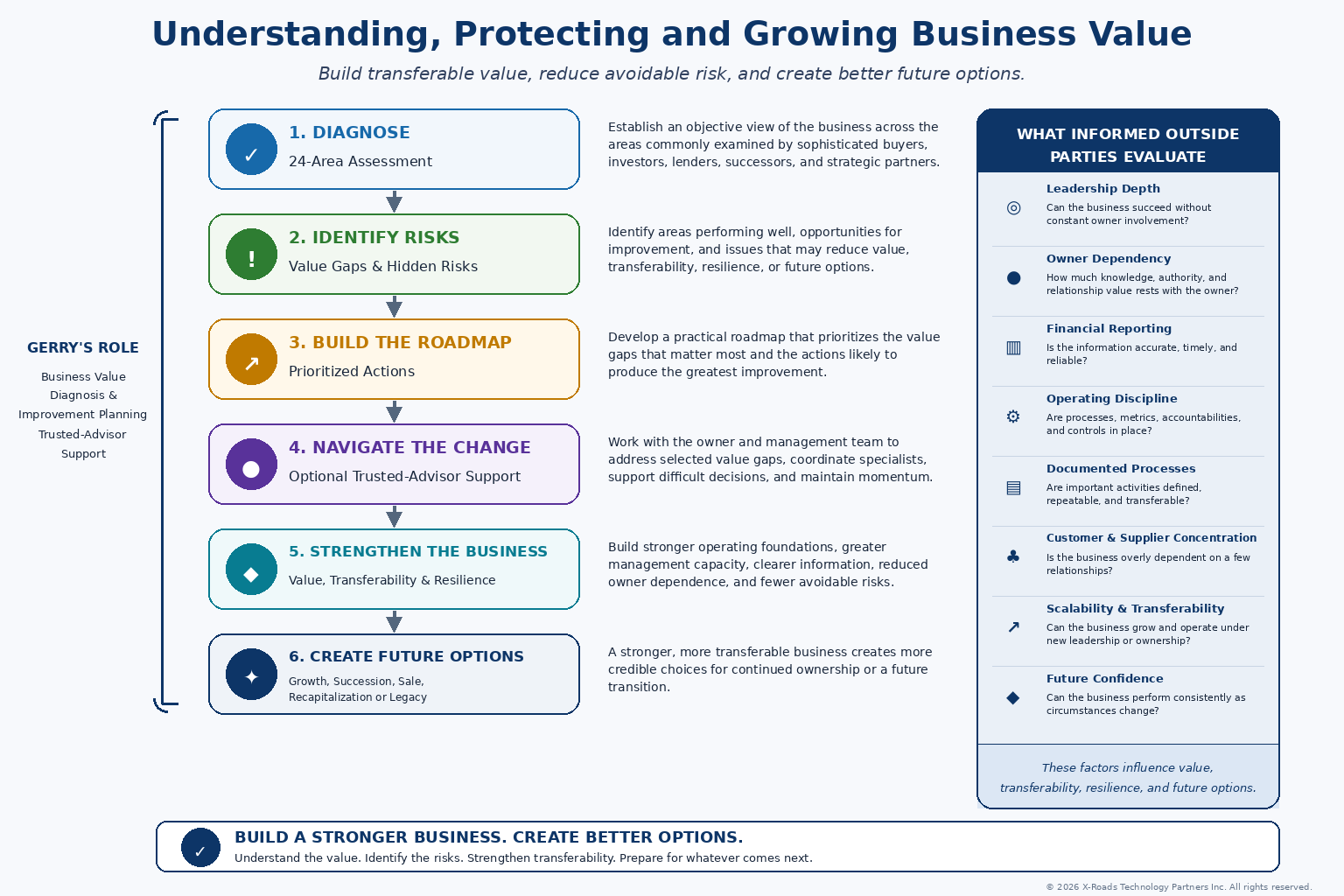
Understanding, protecting and growing business value
Build transferable value, reduce avoidable risk, and create better future options.
Gerry's role: Business value diagnosis and improvement planning. Trusted-advisor support.
Diagnose
24-area assessment
Establish an objective view of the business across the areas commonly examined by sophisticated buyers, investors, lenders, successors, and strategic partners.
Identify risks
Value gaps and hidden risks
Identify areas performing well, opportunities for improvement, and issues that may reduce value, transferability, resilience, or future options.
Build the roadmap
Prioritized actions
Develop a practical roadmap that prioritizes the value gaps that matter most and the actions likely to produce the greatest improvement.
Navigate the change
Optional trusted-advisor support
Work with the owner and management team to address selected value gaps, coordinate specialists, support difficult decisions, and maintain momentum.
Strengthen the business
Value, transferability and resilience
Build stronger operating foundations, greater management capacity, clearer information, reduced owner dependence, and fewer avoidable risks.
Create future options
Growth, succession, sale, recapitalization or legacy
A stronger, more transferable business creates more credible choices for continued ownership or a future transition.
What informed outside parties evaluate
- Leadership depth
- Can the business succeed without constant owner involvement?
- Owner dependency
- How much knowledge, authority, and relationship value rests with the owner?
- Financial reporting
- Is the information accurate, timely, and reliable?
- Operating discipline
- Are processes, metrics, accountabilities, and controls in place?
- Documented processes
- Are important activities defined, repeatable, and transferable?
- Customer and supplier concentration
- Is the business overly dependent on a few relationships?
- Scalability and transferability
- Can the business grow and operate under new leadership or ownership?
- Future confidence
- Can the business perform consistently as circumstances change?
These factors influence value, transferability, resilience, and future options.
Build a stronger business. Create better options.
Understand the value. Identify the risks. Strengthen transferability. Prepare for whatever comes next.
The exploratory conversation
Every engagement starts with a brief exploratory conversation.
This initial discussion allows us to understand your objectives, answer questions about the process, and determine whether a diagnostic would be useful in your situation. In some cases, the conversation confirms that a business is already well positioned. In others, it identifies potential concerns worth investigating further.
The exploratory conversation is intended to help both of us decide whether there is value in proceeding.
What happens if we proceed with the diagnostic?
The diagnostic is designed to create an objective view of the business using many of the same factors that sophisticated buyers, investors, lenders, successors, and strategic partners often evaluate when assessing future performance and risk.
The assessment combines decades of executive and advisory experience with structured, industry-leading third-party analytical tools designed to evaluate transferable value, identify business risks, and highlight opportunities for improvement.
The process typically begins with a 60 to 90 minute discussion with the owner. In some cases, a short follow-up discussion may be required to clarify specific information before the assessment is finalized.
What will this require from the owner?
Most owners are surprised by how little time and preparation the process requires.
A typical engagement includes:
- One 60 to 90 minute diagnostic discussion
- An occasional 30 minute clarification discussion if required
- One 30 to 60 minute findings review meeting
The entire process is normally completed within approximately two weeks from the initial discussion to the final debrief.
Preparation requirements are intentionally kept to a minimum. In most cases, the only information requested in advance is:
- The last two years of income statements
- A current year-to-date income statement, if available
The focus of the diagnostic is understanding how the business operates, where risks exist, and what may affect future value, transferability, and future options. It is not an audit, due diligence engagement, or detailed financial review.
How can the assessment be completed so quickly?
This is one of the most common questions owners ask.
The diagnostic is designed to focus on the factors that most commonly affect value, transferability, resilience, and future options. Rather than conducting an open-ended consulting study, the process uses a structured assessment framework supported by industry-leading third-party analytical tools.
Combined with decades of experience reviewing owner-managed businesses, this allows meaningful insights, benchmarks, and priorities to be developed without requiring months of meetings, interviews, and analysis.
The objective is not to produce a lengthy consulting report. The objective is to identify what matters most and establish clear priorities for action.
What will I receive?
At the conclusion of the diagnostic, you receive a structured assessment of the business and the factors influencing future value.
Deliverables typically include:
- Identification of key value gaps and business risks
- A business value benchmark
- An estimate of current transferable value
- An estimate of potential value if selected value gaps are addressed
- A prioritized roadmap showing where improvement efforts are most likely to have impact
- Recommendations for next steps
- Identification of areas where specialist support may be beneficial
The value benchmark is often one of the most useful parts of the process. It provides an estimate of the business's current transferable value and an estimate of the value that may be achievable if key value gaps are addressed.
For many owners, it is the first time they have seen a structured comparison between where the business stands today and what it could potentially become.
What happens after the diagnostic?
For some owners, the diagnostic itself provides the clarity they were looking for.
Others decide to begin addressing selected value gaps and risks identified during the process.
There is no required follow-on engagement.
Some owners choose to:
- Implement improvements internally
- Work with their existing advisors
- Engage specialists with expertise in specific areas
- Retain Gerry for ongoing trusted-advisor support
The appropriate next step depends entirely on the owner's objectives, priorities, and timeline.
How do existing advisors fit into the process?
Most business owners already have trusted advisors.
That may include wealth advisors, accountants, lawyers, bankers, business consultants, valuation specialists, or M&A professionals.
The diagnostic is designed to complement those relationships, not replace them. When opportunities or risks are identified, existing advisors frequently play an important role in helping implement solutions.
Where additional expertise is required, introductions can be made to appropriate specialists. Gerry's role is often to help identify priorities, coordinate discussions, and support decision-making throughout the process.
Common questions
The diagnostic examines the risks that affect value, transferability, and future performance. In practice that means conversations with the owner and usually one or two other people in the business, a review of financial and operating information, and a structured assessment of the risk areas a buyer or successor would examine. It is a review rather than an audit.
It also includes a business value benchmark that helps establish a practical view of how the market may currently see the business.
This is not a formal valuation intended for legal, tax, or litigation purposes. It is a planning tool that helps owners and advisors understand the factors influencing value and where improvement opportunities may exist.
Most diagnostics can usually be completed in less than two weeks once client availability and the necessary information are in place. If the business is unusually complex, I will say so early and provide a realistic timeframe before we go further.
Some of it, but deliberately not all of it. I am not the right resource for every issue I identify, and pretending otherwise would not serve you. Part of my role is knowing who is.
Ready to start the conversation?
The first step is a brief exploratory conversation.
There is no preparation required before that discussion and no obligation to proceed beyond it.